B.N.Narahari Achar had presented the date of Mahabharata war and related observed events described in the epic with extraordinary accuracy by Veda Vyasa in an international colloquium (January 2003). Further researches by him have established the Mahabharata as the sheet-anchor of the history of Bharatam. The textual references (Critical edition of Bhandarkar Institute) of observed events are related to either planets or comets. In this note (July 2006), Achar establishes that some references are emphatically to comets (mentioned as such in the text itself; graha means both 'planet' and 'comet' and has to be interpreted in context). This brilliant insight resolves the centuries' old problem of apparent inconsistencies within the critical edition of the text. In fact, there are no inconsistencies. Mahabharata is astonishingly accurate, making it the most authentic historical document in human civilizational history.
Continuing the path-breaking use of planetarium software (of the type used by NASA to launch satellites into cosmos), Achar also validates the date of Nirvana of the Buddha. This date is consistent with the Tibetan Bauddha tradition which notes that Gautama the Buddha lived in 19th century BCE. The skymaps of the 3067 and 1807 BCE map the important dates in Hindu civilization: the Great War and the Nirvana of the Buddha, respectively.
Kalyanaraman (20 July 2006). Vyasa-Dhritarashtra Samvada by BN Achar
Annals of BORI, LXXXIV, (2003), pp 13-22). This document establishes 1) the concordance between Atharvaveda Paris'is.t.a and the Mahabharata in relation to the accounts related to comets and 2) internal consistency of astronomical observations recorded in Udyogaparvan and Bhishmaparvan.
S. Kalyanaraman (28 July 2006).
Reclaiming the Chronology of Bharatam
B. N. Narahari Achar
Abstract
The Date of the Mahabharata War has been determined uniquely to be 3067 BCE, on the basis of archaeo-astronomical investigations using planetarium software and the references to astronomical events found in the epic. As has been emphasized by many scholars, this date should be taken as the ‘sheet-anchor’ for the chronology of Bharatam. However, the History of India has been written using the dates of Alexander and Megasthenese as fixed points in time and a chronology given on the basis of AIT or some variant there of. These accounts have been repeated so often that they have acquired the status of ‘ground-truth’. It is important therefore to reclaim the proper chronology of Bharatam
There are a number of problems in reclaiming the proper chronology. First of all, there are several dates given traditionally as the date of the Mahabharata War. For example there are the dates based on the beginning of Kaliyuga, 3102 BCE on the astronomical basis or 3138 BCE based on the departure of Krishna as per the Bhatavata Purana account. Then there is the date 2449 BCE, attributed to Varahamihira and quoted by Kalhana in Rajatarangini. Further, there is the puranic tradition based on the genealogical lists that there was a period of 1500 years elapsed between Parikshit and the Nandas. These different dates have to be reconciled with the date 3067 BCE.
Secondly, the Dates of Buddha, Adishankara and Kalidasa should be taken as fixed points in the chronology. Here an attempt is made to reconcile the differences in the so-called traditional dates of the Mahabharata war, based on the textual evidence in the epic itself. Preliminary results based on archaeoastronomical investigations into the date of Buddha as recorded in Samyutta Nika_ya indicate the emergence of a consistent chronology. Work is in progress to reexamine some epigraphical evidence using planetarium software. The author is confident that a completely consistent chronology will emerge with the date of Mahabharata war as the sheet-anchor.
I. Introduction
It is universally acknowledged that Bha_ratam has one of the most ancient cultural traditions, which unlike the other ancient cultural traditions has been preserved continuously without a break even to the present day.[1] Western Scholars, while grudgingly acknowledging this unbroken tradition, have complained that Indians lack a sense of history and do not have a historical tradition. Therefore, they decided to write a history for Bha_ratam, which is based on their own ideas of history. They have accepted the dates of Alexander and Megasthenese of the Greek tradition as fixed points of history. Using some data from genealogical lists from the Pura_n.a s and the so-called Aryan Invasion Theory (AIT) or some variant there of, the scholars have a chronology for India. These scholars have discounted the fact that two of the greatest epics of the world, Rama_yan.a and Maha_bha_rata are traditionally regarded as itiha_sa s, i.e., historic texts and that there are a host of supporting texts in the form of Pura_n.a- s. Ignoring the fact that Bha_ratam has its own sense of history and its purpose[2], the scholars have systematically misrepresented the chronology of Bha_ratam. It is important to dismiss this false chronology and to reclaim the correct chronology for Bha_ratam.
Based on research over the past several years, using the so-called Planetarium Software and the references to astronomical events in the epic Mahabha_rata, the author has shown[3] that it is possible to arrive at a unique date for the War on the basis of archaeo-astronomical reasoning. This unique date, 3067 BCE, had also been proposed previously by Professor Raghavan. This date should be used as the ‘sheet-anchor’ for the chronology of Bha_ratam.
The plan of the essay is as follows. First, the astronomical references in the epic, Maha_bha_rata from which a date can be ascertained, and the methodology of arriving at a date is summarized and supported by star maps from the planetarium software. It is important to stress that the date of the war is determined solely on the basis of astronomical references in the epic Maha_bha_rata alone and the date is established independently of any other source, as the sheet-anchor for the chronology of Bha_ratam. The consistency of this date with the other texts of Vedic and other traditions is then discussed. This is followed by a discussion of the consistency with the genealogy lists from Pura_n.a texts. A further step in establishing the chronology of Bha_ratam is given in the simulations of the date of astronomical events associated with Buddha nirva_n.a. This essay takes the initial steps in a long way in establishing the chronology of Bharatam through the simulations using planetarium software, and largely agrees with the chronology as advocated by Kota Vekatachelam and a host of other scholars.
II. Archaeo-astronomical Investigations and the Date of the Maha_bha_rata War
The author has explored the astronomical references (of which there are more than one hundred and fifty in number, and occur scattered throughout the epic) using the planetarium software with a view to determine the date of the War. More than 40% of all the articles[4] (totaling more than 120 in number) dedicated to determining the date of the war, are based on the astronomical references. Although the astronomical references are scattered throughout the epic, most of them pertaining to the war occur in Udyogaparvan and Bhi_shmaparvan of the epic. Practically all scholars have characterized the references in Bhi_shmaparvan as astrological omens[5] and inconsistent and not suitable for a ‘scientific’ analysis. The earlier works using the astronomical references were tedious and calculations were done manually and hence chose to use only a couple of the astronomical events out of the many available in the epic. More recent studies have used the computer software ‘planetarium software’ and consequently have considered a much larger number sample of astronomical references in the epic. Still, until recently there appeared to be no convergence of the dates[6]. Some scholars have introduced[7] ad hoc hypotheses in attempting to find some degree of coherence among the apparently ‘inconsistent’ astronomical references. The author has clearly shown that the astronomical references are quite consistent and that such ad hoc hypotheses are totally unnecessary. The research has shown conclusively that
(i) the astronomical references in the Bhi_shmaparvan are not merely ‘astrological effusions fit for mother goose’s tales’ (as once characterized by Professor Sen Gupta), but follow a Vedic tradition of omens and describe mostly comets and not planets as generally assumed,
(ii) the few true planetary references in this parvan are identical to those in Udyogaparvan,
(iii) These common references lead to a unique date for the war, 3067 BCE.
(iv) all other astronomical references in the epic are consistent with the date
(v) The date agrees with the date given earlier by Professor Raghavan and is consistent with the traditional date~3000 BCE.
(vi) Using the planetarium software, it can be easily demonstrated that all other dates proposed by different authors are inconsistent with the planetary configurations referred to in (ii) above.
The important planetary configurations
The important references to planets consist of those that are common to both Udyoga and Bhishmaparvan-s and include the following
(i) conjunction of s’ani with rohin.i
(ii) retrograde motion of anga_raka just before reaching jyesht.ha
(iii) a lunar eclipse on the ka_rtika porn.ima, followed by
(iv) a solar eclipse at jyesht.ha.
These events lead to a unique year for the war. All other references in the epic are consistent with this date.
III. Simulations using Planetarium Software and the date of the war
A search is made for the years in which there is a conjunction of Saturn (s’ani) with Aldebaran (rohini) between 3500 BCE and 500 CE. As Saturn takes an average of 29.5 years to go around the sun once, the event also repeats with the same period. There are 137 such conjunctions during the interval specified above. A search is then made for those years from among these 137 dates when Mars (anga_raka) is retrograde before reaching Antares (jyesht.ha). Since the retrograde motion of Mars repeats with the same period as its synodic period, a spread of two years on either side of each of the dates was considered in the search. The search reduced the set to just seventeen: 3272 BCE, 3067 BCE, 2830 BCE, 2625 BCE, 2388 BCE, 2183 BCE, 1946 BCE, 1741 BCE, 1504 BCE, 1299 BCE, 1061 BCE, 857 BCE, 620 BCE, 415 BCE, 28 CE, 233 CE and 470 CE, when Saturn was near Aldebaran and Mars executed a retrograde motion before reaching Antares. A search is then made for those years in which there is a lunar eclipse near Pleiades (i.e., on the ka_rtika porn.ima). This reduces the set to just two, 3067 BCE and 2183 BCE. It turns out that in both of these years the lunar eclipse is followed by a solar eclipse at jyesht.ha. A sequence of ‘two eclipses within a period of 13 days’ also occurs in the two eclipse seasons. When one considers the fact that Bhi_shma passed away on the Ma_gha s’ukla asht.ami after the occurrence of winter solstice, a unique date results, for the winter solstice in January 13, 3066 BCE occurred on s’uklapan~cami where as the winter solstice in 2182 BCE occurred on krishn.acaturthi.
Thus a unique date of 3067 BCE for the date of the war emerges. The author has shown that this date is consistent with all the other astronomical references in the epic in several publications[8] with the help of copious illustrations of star maps generated by Planetarium software. A couple of the star maps will be included as part of this essay by way of illustration.
Figure 1 shows the star map for September 20, 3067 BCE, corresponding to Ka_rtika Porn.ima. On that day Krishn.a was in Hastinapura for the peace talks. It was also a day of Lunar eclipse. S’ani is clearly seen to be near rohin.i. Figure 2 shows the star map for October 14, 3067 BCE, corresponding to Ama_va_sya at Jyesht.ha. It was a solar eclipse day. Superposed on the star map is the path of Anga_raka which shows a retrograde loop before reaching Jyesht.ha. The retrograde motion of Mars had occurred several months earlier. These two figures clearly show that the important planetary configurations noted earlier occurred in 3067 BCE. Figure 3 shows the day of Bhi_shma’s expiry.
Figure 1 Full Moon of Kartika September 29, 3067 BCE Lunar eclipse day
Figure 2 Solar eclipse day October 14, 3067 BCE
Figure. 3 Bhishma’s expiry Magha shukla ashthami rohini January 17, 3067 BCE
IV. Consistency of the Date of 3067 BCE with tradition
Beginning of kaliyuga and Information from Purana-s
According to Sengupta,[9] there are three traditions regarding the date of the Maha_bha_rata war, namely (i) the so called A_ryabhat.a tradition[10], according to which Pa_nd.avas lived at the beginning of the astronomical Kali age, 3102 BCE; (ii) 2449 BCE, based on the saptarshi tradition as allegedly recorded by Vara_hamihira[11]; (iii) the tradition of the Pura_n.a-s[12], according to which from the birth of Pari_kshit to the accession of Maha_padmananda, there was a time interval is one thousand and five hundred years. Based on the Pura_n.a tradition, modern historians who have identified Candragupta Maurya (who followed the Nanda –s) to have lived in 324 BCE, assign a date ~1900 BCE for the war. All these three will be examined for consistency. It is to be reemphasized that the date of 3067 BCE has been derived independent of any of these traditions and is truly based on the internal evidence based on astronomical references found in the epic alone.
A_ryabhat.a Tradition
A_ryabhat.a declares[13] that when he was 23 years old, 3600 years of Kaliyuga had elapsed. This identifies the beginning of Kaliyuga with 3102 BCE. At first sight there appears to be some question about the consistency of the date 3067 BCE for the war with the beginning of Kaliyuga, which is traditionally thought to have started after the war. A large number of scholars who have proposed the date of ~3000 BCE for the war rely on the information regarding the beginning of Kaliyuga in one-way or the other. However, the epic it self does not explicitly give any information about the beginning of Kaliyuga. It is generally accepted that the astronomical beginning of Kaliyuga coincides with 17/18 February, 3102 BCE. The date of the war is then tied to the beginning of Kaliyuga (which according to some authors coincided with the end of the war and thus giving the date as 3102 BCE for the war). But there are others who take their clue from the Pura_n.as, according to which Kaliyuga began with the departure of Lord Krishn.a from this world, an event occurring after 36 years after the war. This results in the proposed date of 3138 BCE for the war. The spread of +/- 1 year on either side of these dates arises from slightly different modes of counting. Of course, the date 3067 BCE is posterior to 3102 BCE. Is there a conflict? Should not the war precede the beginning of Kaliyuga? Not really. All that the epic says[14] is that the war occurred during the transitional interval between Dva_para and Kaliyuga s, and nowhere it says exactly when the Dva_para ended or Kali began. The antara or the interval between the yugas is quite extensive. According to Vishn.upura_n.a, the sandhya for Dva_para lasts for 200 years and for Kali it is 100 years. Thus there is a period of some 100 years or so, which can be legitimately referred to as sandhya and 3067 BCE falls within this interval of 3102 BCE. In fact, there is some indication that the Kaliyuga had already started by the time of the war[15]. Even Bha_gavata pura_n.a acknowledges[16] that although Kaliyuga had already started, because of the presence of Krishna, Kali’s effect had been controlled. The full power of Kali became effective only with the departure of Krishn.a, according to Kali ra_ja vritta_nta[17] Thus there is no conflict with the war occurring in 3067 BCE and the reckoning of Kaliyuga from 3102 BCE.
The alleged Vara_hamihira Tradition
Vara_hamihira states in his Brihatsamhita that the saptarshi-s were in ma_gha when Yudhisht.hira was ruling and to get the epoch of s’akakala one should add 2526 years to the epoch of Yudhisht.hira Historians have assumed that the s’akaka_la or s’aka nripatika-la refers to the S’a-liva-hana s’aka of 78 CE. Thus arriving at the date -2448 (= 78-2526 ) or 2449 BCE for the Yudhisht.hira Era, the scholars declare that Vara_hamihira gives this as the date of the Maha_bha_rata war. Kalhan.a also assumes that the position of saptarshi –s has been given by Vara_hamihira and makes the same mistake regarding the s’akakala in his Ra_jatarangin.i. However, he assumes that Kaliyuga began in 3102 BCE, hence declares that Pandava–s lived 3102-2449= 653 years after the start of the Kaliyuga. This has only contributed to the confusion and some Indologists actually declare Kaliyuga as a figment of imagination.
Vara_hamihira simply quotes vriddha Garga’s opinion regarding when Yudhisht.hira lived and how to get that period from s’akakala and this is not Vara_hamihira’s opinion. Garga by all accounts lived before CE and the word s’akakala of Garga cannot refer to S’alivahana s’aka of 78 CE. The S’akakala or S’akanripatika_la in Garga’s words refers to the era of the s’aka king, Cyrus, beginning with 550 BCE. All this has been noted by many scholars[18], and discussed in great detail by Kota Venkatachelam[19], whose work may be consulted for further details. With the correct identification of S’akaka_la, the date given by Vara_hamihira is also consistent with the date of the war given here. It may be noted in passing that it was based on the wrong identification of S’akaka_la that Professor Sengupta felt justified in his date of 2449 BCE for the war. Thus the so called Vara_hamihira tradition and the Ra_jatarangin.i tradition of assigning a date 0f 2449 BCE to the war is based on a mistaken identity for the S’akakala compounded by the mistake in assuming that a mere quotation of vriddha Garga by Vara_hamihira reflects the latter’s own opinion. The date derived here is consistent with A_ryabhat.a tradition and the correct S’akakala beginning in 550 BCE.
Saptarshi Era and Genealogy list from Purana-s
The Saptarshi cycle is named after the seven sages and is allegorically associated with the Big Dipper, the eastern most star of which is marked by Mari_ci followed by Vasisht.ha,A_ngirasa, Atri, Pulastya, Pulaha and Kratu, respectively, in that order. The seven sages are thought to move through the twenty-seven nakshatra-s along the Ecliptic at the rate of one nakshatra per 100 years and to complete one cycle in 2700 years. This forms a convenient cycle for reference, but no astronomical significance[20] for the movement and the association of the stars of the Big Dipper can be ascribed. According to Puran.a-s, it is accepted[21] that Saptarshi -s were in ma_gha when Yudhisht.hira ascended the throne and that the time interval from Pari_kshit to the accession of the Nanda kings was 1500 years. Between Pari_kshit and the Nandas, there were three royal dynasties, Brihadratha, Pradyota and S’is’unaga families. The Nandas were followed by Mauryas, Sungas, Kan.vas, and A_ndhras. The Saptarshi -s returned to ma_gha during the reign of the 24th king of the A_ndhras. It was the 25th king, Gautami_putra S’a_takarn.i who performed the as’vamedha and ra_jasu_ya yaga. It is simply being recalled that the Saptarshi –s had returned to the position they had occupied during the time when these rituals had been performed earlier at the time of the Pand.ava-s. The reason for this remembrance is that during this interval of 1500 years, there had been a decline of Vedic performances due to the ascendancy of Buddhism especially during the reign of the king As’oka Maurya. Since 1500 years had passed till the time of Nandas, As’oka Maurya’s time must have been about a hundred years later, i.e., 1500 BCE. The Andhras were followed by the Guptas and the Pramaras. In the accounts given by historians there is a mix up of the Gupta king, Samudra Gupta, who was also known as As’okaditya Priyadars’in and who lived around 320 BCE, with As’oka of the Maurya Dynasty, the dynasty which had ruled Magadha from 1535 BCE -1219 BCE.. The celebrated inscriptions of Priyadars’in–Rock Edicts III and XIII-mention Antiochus and Ptolemy as contemporaries of Priyadars’in, who is in reality Samudra Gupta of the Gupta Dynasty. The Gupta Dynasty ruled Magadha from 328 BCE- 83 BCE and not the Mauryas. This confusion is the reason for assigning the wrong date for the Maha_bha_rata war based on the Puran.ic genealogy lists. The confusion in the chronology of Bharatam is compounded by the historians, who misidentify King Vikrama_ditya of the Pramara Dynasty, who established the Vikrama Era in 57 BCE. When proper identification of As’oka is made, it is seen that all the traditions, namely, (i)A_ryabhat.a’s Kaliyuga, (ii) Saptarshi tradition and (iii) the Puran.ic tradition are all consistent with the date 3067 BCE for the war.
Buddha’s Nirvana
Kota Venkatachelam has determined that Buddha’s Nirva_n.a occurred on the vais’a_kha porn.ima on March 27, 1807 BCE. Simulations show that astronomically this is indeed the situation as shown in Figure 3. Many other scholars also agree as to the date of Buddha’s Nirvana.
Support for this date is derived from an independent Buddhist source, Samyutta Nika_ya. For about three months before his death, Buddha was staying in S’ra_vasti. During this time there occurred the winter solstice, a lunar eclipse, followed by a solar eclipse. Simulations show that the winter solstice occurred on January 5, 1807 BCE. There was a lunar eclipse on January 26, 1807 BCE, which was followed by a solar eclipse on February 10, 1807 BCE, as shown in Figures 4 and 5. It can also be seen from Figure 5 that winter solstice occurred earlier when the Sun was near dhanisht.ha (the position which corresponds to 270° along the ecliptic).
This is exactly as recorded[22] in Samyutta Nika_ya Part I, Sugata-Vagga Book II, Chapter I, Devaputta-samyuttam sutta-s 9, and 10.
It is interesting to compare these simulations with the calculations of Professor Sengupta, who was trying to confirm the usually ‘accepted’ date of 544 BCE for the event of Buddha Nirvana. He found that two eclipses as mentioned in the Samyutta Nika_ya would be possible in 560 BCE, however this would be in conflict with the dates 483 BCE and 544 BCE which have been touted as possible dates of Buddha Nirva_n.a.
The conclusion is that neither of these dates are the correct ones according to Samyutta Nikaya.
Figure 4. Star Map for March 27, 1807 BCE: Full Moon at vishakha; Buddha’s nirvana
Figure 5. Lunar Eclipse on January 26, 1807 BCE
Figure 6. Solar Eclipse on February 10, 1807 BCE
Conclusions
It has been shown that the date of 3067 BCE for the Maha_bha_rata War, derived on the basis of astronomical references from the epic alone is consistent with the different traditional dates assigned to the war when proper allowance is made to the different assumptions implicit in the traditions. The date is also consistent with the so called Saptarshi tradition. A big first step is taken in establishing the consistency with the date of Buddha by simulations of the astronomical references in Samyutta Nikaya using Planetarium software. This is a work in progress to reclaim the chronology of Bha_ratam.
List of Figures
Figure 1 Full Moon of Kartika September 29, 3067 BCE Lunar eclipse day
Figure 2 Solar eclipse day October 14, 3067 BCE
Figure 3 Bhishma’s expiry Magha shukla ashthami rohini January 17, 3067 BCE
Figure 4 Star Map for March 27, 1807 BCE: Full Moon at vishakha; Buddha’s nirvana
Figure 5 Lunar Eclipse on January 26, 1807 BCE
Figure 6 Solar Eclipse on February 10, 1807 BCE
Bibliography
Basham, A.l., (1953), The Wonder that was India, Grove Press Inc., New York
M. Ramakrishna Bhat, Vara_hamihira’s Brhatsamhita Part I. Edited with English translation. (Delhi : Motilal Banarsidass, 1981).
Gupta S. P. and Ramachandran, K. S.,(1976), (editors) Mahabharata, Myth and Reality-Differing Views, Agam Prakashan, Delhi;
Kamath, S. U., (Bangalore, 2004), (Editor) The Date of the Mahabharata War Based on Astronomical Data, Mythic Society
Majumdar, R. C., Raychaudhuri, H. C., Kalikinkar Datta, (1978) An Advanced History of India, Macmillan India Pvt. Ltd. , Madras
Narahari Achar, B. N., (2005) “Planetarium Software and the Date of the Mahabharata War” in The Mahabharata: What is not here is nowhere else, Edited by T. S. Rukmani,
Munshiram Manoharlal Publishers, PVt Ltd, New Delhi India pp. 247-263.
Narahari Achar, B. N., (2004) “Date of the Mahabharata War Based on Simulations Using Planetarium Software” in The Date of the Mahabharata War Based on Astronomical Data, Edited by Suryanath U. Kamath, Mythic Society, Bangalore, India pp. 65-115.
Narahari Achar, B. N., (2004) “Planetary Configurations in the Epic Mahabharata: Revising an Exercise in Archaeoastronomy” Paper presented at the 7th Oxford International Conference on Archaeoastronomy, Flagstaff, Arizona (to appear in print)
Ramachandran, V. G.,(1998) ‘ Date of Adi Sankara’ in Ancient India, Mahalingam, N., (Ed), International Society for the Investigation of Ancient Civilization, Chennai.
Pp.261-304
Raychaudhuri, H. C., (1923), Political History of Ancient India, University of Calcutta, Calcutta, p. 10
Sathe, S.,(1983) Search for thr Year of the Bharata War, Navabharati Publications, Hyderabad
Sengupta, P. C., (1947) Ancient Indian Chronology, University of Calcutta, Calcutta.
Sircar, D. C., (1969), “The Myth of the Great Bharata War”, in The Bharata War and the Puranic Geneologies, University of Calcutta, pp 11-27
Vaidya, C. V.,(1983) The Mahabharata A criticism, Cosmo Publications, New Delhi, p. 80.
Vedavyas, E., (1986), Astronomical Dating of the Mahabharata War, Agam Kala Prakashan, Delhi.
Kota Venkatachelam, (1954)The Plot in Indian Chronology, Arya vijnana, Vijayavada
[1] Basham, A.l., (1953), The Wonder that was India, Grove Press Inc., New York
[2] dharma_rtha ka_ma moksha_n.a_m upadesha samanvitam |
pu_rvavrittam katha_yuktam itiha_sam pracakshate ||
[3] Narahari Achar, B. N., (2006), ‘Date of the Mahabharata War on the basis of simulations using the Planetarium Software’, The Hindu Renaissance, Vol IV, no. 1, pp 8-13.
[4] Sathe (1983)
[5]Sengupta, P. C., (1947) Ancient Indian Chronology, University of Calcutta, Calcutta.
[6] Kamath, S. U., (Bangalore, 2004), (Editor) The Date of the Mahabharata War Based on Astronomical
Data, Mythic Society.
[7] It has been common to make ad hoc assumptions to fit whatever model one is proposing and to bring
some degree of consistency in the astronomical references in the Epic. For example, Sengupta [14]
assumed that the pair of eclipses had occurred two years before the war and later inserted into the text.
Sharma (quoted by Iyengar in his paper in [15], p. 151) assumed that Vyasa met Dhritarashtra not just
once on the eve of the war, but several times and the planetary positions refer to different times. Iyengar
(in [15], p.167) assumed that part of the text in Bhishmaparvan actually belongs to sabhaparvan and
would rearrange the text of the epic to suit his model.
[8] Cited in the Bibliography
[9] Sengupta (1947)
[10] kaho manavo }ha manuyugah shkha gatastemanuyugahchnaca |
kalpaderyugapadagaca gurudivasacca bharatatpurvam || A.I.5 ||
[11] asanmaghasu munayah shasati prthvim yudhishthire nrpatau |
shadvika pancadviyutah shakakalah tasyarajnasyat ||BrS.13.3||
[12] yavat parikshito janma yavat nandabhishecanam |
evam varsha sahasrantu jneyam pancashatottaram || bhaga III, a. III||
[13] shashtyabdanam shashtiryada vyatitastrayashca yugapadah |
tryadhika vimshatirabdastadeha mama janmanotitah || A. III. 10||
[14] see foot note # 8 above
[15]etad kaliyugam nama aciradyatpravartate || MB. III.148.37||
The following remark is made when during the gadayuddha, Bhima hits Duryodhana’s thigh, the adharma act being the result of Kali having already entered.
prmptam kaliyugam viddhi pratijnam pandavasyaca || MB IX.59.21||
[16] yada mukundo bhagavanimam mahim jahau svatanvan shravanjya satkathah|
tadahareva pratibuddhacetasam abhadrahetuh kaliranvavartata ||BP I.15.36||
[17] yavat sa bhagavan vishnuh paspashemam vasundharam |
tavat prthvim parakrantum samartho nabhavat kalih|| bhaga III, a. III ||
[18] Vaidya, C. V.,(1983) The Mahabharata A criticism, Cosmo Publications, New Delhi, p. 80.
[19] Venkatachelam (1954).
[20] This is the reason why Varahamihira simply quotes Garga regarding the position of Sapta Rshi–s and does not express his own opinion of it. It may also be noted that the two stars, kratu and pulaha, ‘the pointers’, point toward the polestar polaris, now, but not in 3000 BCE. Then the pole star was Thuban (Dhruva) and the entire Satarshi mandala was circumpolar.
[21] A detailed discussion of these points are given by Kota Venkatachelam and summarized by Vedavyas.
[22] Atha kho bhagava candimam devaputtam arabha rahum asurindamgathaya ajjabhasi ||
thatagatam arahantam | candima saranam gato ||
rahu candam pamuncassu | Buddha lokanukampakati || SN (I. ii . 1. 9.3) ||
Atha kho bhagava suriam devaputtam arabha rahum asurindam gathaya ajjabhasi ||
thatagatam arahantam | suriyam saranam gato ||
rahu pamunca suriyam | Buddha lokanukampakati || SN (I. ii . 1. 10.3) ||
Sunday, August 2, 2009
Reclaiming the chronology of Bharatam by B.N.Narahari Achar
Monday, February 16, 2009
Mathura: Evidence of Shri Krishna Mandir


Just like in the case of two (of the seven) holiest cities for Hindus "Ayodhya" which is Shri Ram Janmabhoomi, the birth place of God Shri Ram and "Kashi" (aka Varanasi/Banaras) which has Kashi Vishwanath ji, one of the most important Jyotirling of God Shiv ji and thousands of other important Holy temples around Bharat like Shri Somnath Jyotirling Mandir (thank god for Sardar Vallabhbhai Patel ji for reclaiming its honor by restoring the Mandir) in Saurashtr were all encroached upon by Muslim foreign invaders Mughals and then destroyed to build their own structures as a symbol of Mughal rule on Hindus. So was also done in the other holy city (of the seven cities) for Hindus, "Mathura" which is Shri Krishna Janmabhoomi, the birth place of God Shri Krishna, not once but four times. Latest being Mughal barbarian Aurangzeb who destroyed the Mandir in 1669 to build Idgah Qila over it.
Clearly Mughals had a problem with holy Hindu locations that they always wanted to destroy the Hindu temples at places of extreme importance (for Hindus), primarily birthplaces of Hindu Gods, as a symbol of their conquer over Hindu psyche and honor just like Muslim Taliban had a problem with Bahamian Buddha Statues in Afghanistan.
Here are the few articles/evidence of the same:
- 10000 yrs old Evidence of Dwarka city found underwater
- Tired of Ayodhya? Wait until the Parivar comes here by Indian Express on July 9, 2003
come to Mathura. And listen to a group of boys chanting the many names of Krishna. Watch one of them, Jayant Kanodia, as he along with his friends walks to a corner, peers through rolls and rolls of concertina. Then points at the courtyard of the 334-year-old imposing Shahi Idgah.
Anti-Hindu and pro-Congress bias of Indian Express is not hidden from anyone but it is stark in this article by Rakesh Sinha. For why else would you title an article "Tired of Ayodhya?". Mr. Sinha, you and other pseudo-secular fanatics may be tired of Ayodhya but you know what it is hard to just forget the sacrifice of Millions of Bharatvaasi (misnomer: Indian) to save the honor of Bharat and Hindus from barbarian Mughals. So no, unfortunately we are not tired of Ayodhya and will not be untill justice is delivered. Hopefully you will learn to mutually respect Hindus someday.
‘‘This is no masjid,’’ Jayant smirks. It’s just a dhaancha, built over janmasthan land.’’ His friends nod.
And almost everyone ready to explain how Lord Krishna’s birthplace has been ‘‘violated,’’ most recently by Aurangzeb, five generations removed from Babar, almost 10 from today. Depending which side you are on, you interpret the image: the Krishna Chabutra, a marble pavilion over the ‘‘garbha griha,’’ in perfect harmony with the Idgah.
Or dwarfed by its rear walls and huge green-white domes. Ringed by men of the CRPF 130 Battalion. Jayant and his friends have come all the way from Kota to Mathura, joining a crowd that numbers about 500 this afternoon. In contrast, the mosque is deserted, CRPF jawans standing guard.
They talk of the Mathura shrine ‘‘liberation’’ being on the Sangh Parivar’s agenda. So what if this Krishna Janmabhoomi-Shahi Idgah masjid complex is covered under the Places of Worship (Special Provisions) Act, 1991, which provides for maintenance of the religious character of a place of worship as it existed on August 15, 1947.
Near the entrance to the sanctum sanctorum is a board which explains it all: four temples built but destroyed. The Shri Krishna Janmasthan Seva Sansthan distributes literature which gives you an account of the temples built at the Janmasthan: a stone inscription in Brahmi, dating back to the 1st Century BC, speaks of the reign of Kshatrapa Shodasa and a man named Vasu who got a temple, an arched doorway and an altar built at the birthplace of Krishna.
The second temple at the site came up during the rule of Chandragupta Vikramaditya. It was destroyed in 1017 AD by Mahmud of Ghazni. In Katra Keshavdev, they found an inscription on a stone slab which speaks of the third temple, built by Jajja in Vikrama Samvat 1207 (1150 AD) during the rule of Vijaypal Deva. It’s said Chaitanya Mahaprabhu visited the same temple when he came to Mathura before its destruction by the forces of Sikandar Lodhi in the 16th Century.
The fourth temple, the destruction of which is the source of the modern controversy, was built by Veer Singh Dev Bundela of Orchha when Jehangir was on the Mughal throne. But Aurangzeb’s said to have ordered its destruction in 1669 and the present-day Idgah was constructed over a part of the raised plinth of the Keshavdev temple.
Vijay Bahadur Singh, the Trust security officer, gives you a lowdown on subsequent events: auction of the land by the British, the law suits between Muslims and Hindus, the role of Madan Mohan Malviya and others in restoring the land and the establishment of the Trust with G V Mavalankar as its first president. - Shree Krishnajanmabhoomi Temple
The Mathura administration has found clinching evidence which proves the Hindus' claim that the Shahi Mosque at Mathura was built over Shri Krishnajanmabhoomi temple.
According to the locals, on August 14 the local administration started digging in the courtyard of the mosque for construction of some rooms for the security staff. During the digging the labourers found stone pillars, carving and an idol of a Hindu God. They immediately reported that matter to the authorities.
As news of the recovery of the idol from the courtyard of the Shahi Mosque spread, senior police and administrative officials and members of Shri Krishnajanmabhoomi Trust reached the spot. The patron of the Trust, Shri Gopeshwar Chaturvedi, told this correspondent that during digging between August 14 and 17, besides carved stones and pillars, an idol of a Hindu God with a snake over its head was found. - Krishna janma bhoomi
- For more on history of Ayodhya, brutality of Muslim/Mughal rulers like Babur and evidence of Shri Ram Mandir destroyed by Babur, please watch the video below:
श्रीमद् भगवद्गीता चलचित्र / Shrimad Bhagwad Geeta video
Let us together watch God Shri Krishn ji speak Shrimad Bhagwad Geeta to Arjun in Dharmshetr Kurukshetr during the Dharm Yudh (War for righteousness and moral ethics). We are lucky and obliged to listen to the Bhagwanuvach (God's word from his mouth) on the mystery of Karm, Gyan, and Bhakti Yog. ॥Jai Shri Krishn॥
Wednesday, February 4, 2009
What the Islamic Invaders did to India
On the anniversary of the Babri Masjid demolition (December 6, 1992), it is important for Hindus (and Muslims) to understand the importance of the event in the context of Hindustan's history, past and recent, present and the future.
Savages at a very low level of civilisation and no culture worth the name, from Arabia and west Asia, began entering India from the early century onwards. Islamic invaders demolished countless Hindu temples, shattered uncountable sculpture and idols, plundered innumerable palaces and forts of Hindu kings, killed vast numbers of Hindu men and carried off Hindu women. This story, the educated-and a lot of even the illiterate Indians-know very well. History books tell it in remarkable detail. But many Indians do not seem to recognise that the alien Muslim marauders destroyed the historical evolution of the earth's most mentally advanced civilisation, the most richly imaginative culture, and the most vigorously creative society.
It is clear that India at the time when Muslim invaders turned towards it (8 to 11th century) was the earth's richest region for its wealth in precious and semi-precious stones, gold and silver, religion and culture, and its fine arts and letters. Tenth century Hindustan was also too far advanced than its contemporaries in the East and the West for its achievements in the realms of speculative philosophy and scientific theorising, mathematics and knowledge of nature's workings. Hindus of the early medieval period were unquestionably superior in more things than the Chinese, the Persians (including the Sassanians), the Romans and the Byzantines of the immediate proceeding centuries. The followers of Siva and Vishnu on this subcontinent had created for themselves a society more mentally evolved-joyous and prosperous too-than had been realised by the Jews, Christians, and Muslim monotheists of the time. Medieval India, until the Islamic invaders destroyed it, was history's most richly imaginative culture and one of the five most advanced civilisations of all times.
Look at the Hindu art that Muslim iconoclasts severely damaged or destroyed. Ancient Hindu sculpture is vigorous and sensual in the highest degree-more fascinating than human figural art created anywhere else on earth. (Only statues created by classical Greek artists are in the same class as Hindu temple sculpture). Ancient Hindu temple architecture is the most awe-inspiring, ornate and spell-binding architectural style found anywhere in the world. (The Gothic art of cathedrals in France is the only other religious architecture that is comparable with the intricate architecture of Hindu temples). No artist of any historical civilisation have ever revealed the same genius as ancient Hindustan's artists and artisans.
Their minds filled with venom against the idol-worshippers of Hindustan, the Muslims destroyed a large number of ancient Hindu temples. This is a historical fact, mentioned by Muslim chroniclers and others of the time. A number of temples were merely damaged and remained standing. But a large number-not hundreds but many thousands-of the ancient temples were broken into shreds of cracked stone. In the ancient cities of Varanasi and Mathura, Ujjain and Maheshwar, Jwalamukhi and Dwarka, not one temple survives whole and intact from the ancient times.
The wrecking of Hindu temples went on from the early years of the 8th century to well past 1700 AD a period of almost 1000 years. Every Muslim ruler in Delhi (or Governor of Provinces) spent most of his time warring against Hindu kings in the north and the south, the east and the west, and almost every Muslim Sultan and his army commanders indulged in largescale destructions of Hindu temples and idols. They also slaughtered a lot of Hindus. It is easy to conclude that virtually every Hindu temple built in the ancient times is a perfect work of art. The evidence of the ferocity with which the Muslim invaders must have struck at the sculptures of gods and goddesses, demons and apsaras, kings and queens, dancers and musicians is frightful. At so many ancient temples of Rajasthan and Madhya Pradesh, for example, shattered portions of stone images still lie scattered in the temple courtyards. Considering the fury used on the idols and sculptures, the stone-breaking axe must have been applied to thousands upon thousands of images of hypnotic beauty.
Giving proof of the resentment that men belonging to an inferior civilisation feel upon encountering a superior civilisation of individuals with a more refined culture, Islamic invaders from Arabia and western Asia broke and burned everything beautiful they came across in Hindustan. So morally degenerate were the Muslim Sultans that, rather than attract Hindu "infidels" to Islam through force of personal example and exhortation, they just built a number of mosques at the sites of torn down temples-and foolishly pretended they had triumphed over the minds and culture of the Hindus. I have seen stones and columns of Hindu temples incorportated into the architecture of several mosques, including the Jama Masjid and Ahmed Shah Masjid in Ahmedabad; the mosque in the Uparkot fort of Junagadh (Gujarat) and in Vidisha (near Bhopal); the Adhai Din Ka Jhonpra right next to the famous dargah in Ajmer-and the currently controversial Bhojshala "mosque" in Dhar (near Indore). Hindu culture was at its imaginative best and vigorously creative when the severely-allergic-to-images Muslims entered Hindustan. Islamic invaders did not just destroy countless temples and constructions but also suppressed cultural and religious practices; damaged the pristine vigour of Hindu religion, prevented the intensification of Hindu culture, debilitating it permanently, stopped the development of Hindu arts ended the creative impulse in all realms of thought and action, damaged the people's cultural pride, disrupted the transmission of values and wisdom, cultural practices and tradition from one generation to the next; destroyed the proper historical evolution of Hindu kingdoms and society, affected severely the acquisition of knowledge, research and reflection and violated the moral basis of Hindu society. The Hindus suffered immense psychic damage. The Muslims also plundered the wealth of the Hindu kingdoms, impoverished the Hindu populace, and destroyed the prosperity of Hindustan.
Gaze in wonder at the Kailas Mandir in the Ellora caves and remember that it is carved out of a solid stone hill, an effort that (inscriptions say) took nearly 200 years. This is art as devotion. The temple built by the Rashtrakuta kings (who also built the colossal sculpture in the Elenhanta caves off Mumbai harbour) gives proof of the ancient Hindus' religious fervor.
But the Kailas temple also indicated a will power, a creative imagination, and an intellect eager to take on the greatest of artistic challenges.
The descendants of those who built the magnificent temples of Bhojpur and Thanjavur, Konark and Kailas, invented mathematics and brain surgery, created mindbody disciplines (yoga) of astonishing power, and built mighty empires would almost certainly have attained technological superiority over Europe.
It is not just for "political reasons" that Hindus want to build grand temples at the sites of the (wrecked) Babri Masjid in Ayodhya, the Gyanvapi mosque in Varanasi, and the Mathura idgah. The efforts of religion-intoxicated and politically active Hindus to rebuild the Ram Mandir, the Kashi Vishwanath Mandir, and the Krishna Mandir are just three episodes m a one-thousand year long Hindu struggle to reclaim their culture and religion from alien invaders.
The demolition of the Babri Masjid in Ayodhya on 6 December 1992 was just one episode in the millennial struggle of the Hindus to repossess their religion-centered culture and nation. Meanwhile, hundreds of ancient Hindu temples forsaken all over Hindustan await the reawakening of Hindu cultural pride to be repaired or rebuilt and restored to their original, ancient glory.
http://www.islam-watch.org/Rizwan_Salim/What-Islamic-Invaders-Did-to-India.htm
This article was published in Hindustan Times in December 1997
Tuesday, December 9, 2008
गीता जयंती की हार्दिक शुभ कामनाये। Happy Geeta Jayanti to all

गीता जयंती की हार्दिक शुभ कामनाये। Happy Geeta Jayanti to all. Geeta Jayanti celebrates the anniversary of the day on which God Shri Krishn ji told the Shrimad Bhagwad Geeta to Arjun. According to the lunar Bharatiya (Indian) calendar, that day is the ११ Shukl (11th bright day) of the Margshirsh month (2nd month) of the Vikram Samvat year.
॥श्री कृष्णं शरणम् ममः॥
- क्यों व्यर्थ की चिंता करते हो? किससे व्यर्थ डरते हो? कौन तुम्हें मार सक्ता है? आत्मा ना पैदा होती है, न मरती है।
- जो हुआ, वह अच्छा हुआ, जो हो रहा है, वह अच्छा हो रहा है, जो होगा, वह भी अच्छा ही होगा। तुम भूत का पश्चाताप न करो। भविष्य की चिन्ता न करो। वर्तमान चल रहा है।
- तुम्हारा क्या गया, जो तुम रोते हो? तुम क्या लाए थे, जो तुमने खो दिया? तुमने क्या पैदा किया था, जो नाश हो गया? न तुम कुछ लेकर आए, जो लिया यहीं से लिया। जो दिया, यहीं पर दिया। जो लिया, इसी (भगवान) से लिया। जो दिया, इसी को दिया।
- खाली हाथ आए और खाली हाथ चले। जो आज तुम्हारा है, कल और किसी का था, परसों किसी और का होगा। तुम इसे अपना समझ कर मग्न हो रहे हो। बस यही प्रसन्नता तुम्हारे दु:खों का कारण है।
- परिवर्तन संसार का नियम है। जिसे तुम मृत्यु समझते हो, वही तो जीवन है। एक क्षण में तुम करोड़ों के स्वामी बन जाते हो, दूसरे ही क्षण में तुम दरिद्र हो जाते हो। मेरा-तेरा, छोटा-बड़ा, अपना-पराया, मन से मिटा दो, फिर सब तुम्हारा है, तुम सबके हो।
- न यह शरीर तुम्हारा है, न तुम शरीर के हो। यह अग्नि, जल, वायु, पृथ्वी, आकाश से बना है और इसी में मिल जायेगा। परन्तु आत्मा स्थिर है - फिर तुम क्या हो?
- तुम अपने आपको भगवान के अर्पित करो। यही सबसे उत्तम सहारा है। जो इसके सहारे को जानता है वह भय, चिन्ता, शोक से सर्वदा मुक्त है।
- जो कुछ भी तू करता है, उसे भगवान के अर्पण करता चल। ऐसा करने से सदा जीवन-मुक्त का आनंद अनुभव करेगा।
- Why do you worry without cause? Whom do you fear without reason? Who can kill you? The soul is neither born, nor does it die.
- Whatever happened, happened for the good; whatever is happening, is happening for the good; whatever will happen, will also happen for the good only. You need not have any regrets for the past. You need not worry for the future. The present is happening.
- What did you lose that you cry about? What did you bring with you, which you think you have lost? What did you produce, which you think got destroyed? You did not bring anything - whatever you have, you received from here. Whatever you have given, you have given only here. Whatever you took, you took from God. Whatever you gave, you gave to him. You came empty handed, you will leave empty handed. What is yours today, belonged to someone else yesterday, and will belong to someone else the day after tomorrow. You are mistakenly enjoying the thought that this is yours. It is this false happiness that is the cause of your sorrows.
- Change is the law of the universe. What you think of as death, is indeed life. In one instance you can be a millionaire, and in the other instance you can be steeped in poverty. Yours and mine, big and small - erase these ideas from your mind. Then everything is yours and you belong to everyone.
- This body is not yours, neither are you of the body. The body is made of fire, water, air, earth and ether, and will disappear into these elements. But the soul is permanent - so who are you?
- Dedicate your being to God. He is the one to be ultimately relied upon. Those who know of his support are forever free from fear, worry and sorrow.
- Whatever you do, do it as a dedication to God. This will bring you the tremendous experience of joy and life-freedom forever.
Saturday, September 22, 2007
Political Maps of India Throughout the Ages
The Myth of the Aryan Invasion
Scientific Verification of Vedic Knowledge and its proofs
Hindu Genocide: Largest in World History
Ayodhya: THE indisputable evidence of Shri Ram Mandir
23000 yrs old Evidence of Dwarka city found underwater
श्री राम सेतु / Shri Ram Setu evidence
===========================================


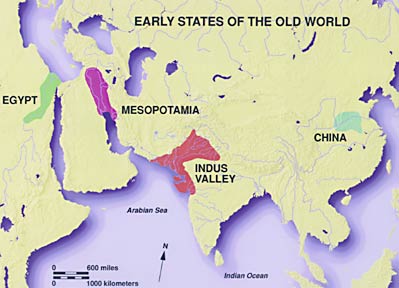
Modern humans (Homo sapiens) settled in India tens of thousands of years ago, and the people of India have not changed much in appearance since then. At the end of the last ice age, they developed farming, due to changing climate. Eventually, they created one of the world's first civilizations along with Egypt and Sumeria. No other civilization at the time was as extensive in geographical area as the Indus-Valley Civilization. It flourished between 3300 BCE and 1300 BCE, at a time when India was in the bronze age.
Ships of the IVC sailed as far west as the Persian Gulf and Africa, and probably just as far east, as part of the earliest trading and sharing of ideas. Their cities were amongst the largest and most advanced of the world. Eventually, they began adopting foreign languages and religious practices, which combined with existing Indian ones, to form Vedism and Sanskrit. The Vedas, some of the earliest documents in human history, were composed during this era.
1000 BCE - The Mahajanapadas
When the cities around the Indus valley were slowly abandoned due to changing climate, the rest of India began to increase in importance, perticularily around the Ganges valley. Slowly, numerous tribes, minor kingdoms, chiefdoms and clans adopted Vedic practices across India, and incorporated it into their existing beliefs.
Sixteen kingdoms and republics, similar to the Greek city-states of the same period, rose across India, to become the most powerful states amongst many. They adopted new iron-age technology, and wrote great epics such as the Ramayan and Mahabharat. A great age of invention and philosophy took place across the great civilizations of the world, in India, Greece, China and Persia.
The Buddha and Mahavira founded Buddhism and Jainism in India. The Upanishads, one of the most revolutionary philosophical texts in human history, were written by Hindu philosophers. Panini became the first person to formalise a written language (Sanskrit) with grammar and rules. Even the game of chess was invented.
200 BCE - The Mauyan Dynasty
Inspired by the Persian Empire, the conquests of Alexander, and the revolutionary philosophy of Indian politician Chanakya, India's first emperor, Chandragupta Maurya, united the entire Indian subcontinent a century before the first Chinese emperor united China. He ruled one of the sixteen Mahajanapadas, called Magadha, which had risen to be the most powerful under previous dynasties, and expanded that power even further.
At its height, this empire controlled one third of the population of the planet, and was the richest and largest. It was ruled from Pataliputra, the modern day city of Patna, which was the largest city of the time. It controlled the largest army of the ancient world, and its rulers comissioned some of India's greatest monuments, which have long since collapsed. Its dynasties would continue to rule the Magadhan Empire for centuries, but none would match the Mauryas. Even the small independent kingdoms of the far south, defended by rugged terrain, agreed to pay tribute, and rulers in Sri Lanka adopted Buddhism.
Today, the edicts of Emperor Ashoka, grandson of Chandragupta, can still be read across India, where they were carved almost 2500 years ago. The Indian flag bears the dharma chakra of this ancient emperor, who gave the world the first treaty of human and animal rights, and engaged in massive civil engineering projects, such as road networks lined with trees and wells, and policed by soldiers.
100 BCE
The Shunga dynasty were successors to the Maurya dynasty in the rule of the Magadhan Empire. They managed to rebuild a large area of the empire, which had collapsed under later Mauryan rulers, but ultimatly, could not match the huge Mauryan Empire. In the northwest, in Afghanistan, remnant Greek kings from the time of Alexander, created a kingdom which combined Greek, Persian and Indian civilization, spreading Indian philosophy and art, and combining it with Greek and Persian philosophy and art.
100 CE - Kushan Invasion
A century after the birth of the Christian religion in the middle east, which some suspect was influenced by the earlier Buddhist philosophy of India, one of the greatest empires of the ancient world once again rose in India. A tribe of nomads, from the area of Tibet and Turkestan in modern China, created an empire across Central Asia and India, adopting Indian culture, and allowing trade to flourish between east and west, along the silk route.
India was already the richest region of the planet at this time, according to the estimates of some economic historians, but trade via land with Persia and China, and via sea with the Roman Empire, flooded India with wealth, to the extent that some Roman Emperors were worried that their treasuries were being emptied by trade with India. Buddhism spread even further than before, establishing a foothold in the east, where it is still dominant.
400 CE - Gupta Period
After the fall of the Kushan Empire, another empire rose in Magadha, again ruling from Pataliputra, led by the Gupta dynasty. This is seen by many as a golden age for India. At a time when the people of Europe entered the dark ages, and rejected science and technology, after the fall of the Roman Empire, the Gupta Empire in India was making huge advancements in technology, fine arts, medicine, philosophy and science.
Aryabhata made new discoveries in astronomy, which wouldnt be matched until Europeans invented the telescope a thousand years later. Kalidasa composed great plays in Sanskrit, incorporating advanced themes, a thousand years before Shakesphere. In the south, great Sangham poets did likewise. The concept of zero was invented, allowing a new era of mathematics. Metallurgy and plastic surgery were perfected. Some of their greatest monuments still stand today, and were the prototype for temples across Eastern Asia. Their art influenced scupture in China.
Eventually, the Gupta dynasty would fall to the same nomadic tribes who destroyed the Roman Empire, when after a long struggle, the Huns distroyed it.
625 CE - Harsha
After the Huns had destroyed the Gupta dynasty, Pataliputra again lost its importance. The earlier fall of the Kushans had also left historically powerful cities like Mathura less important, although holy cities like Varanasi and Madurai would retain vast importance as pilgrimage centers. Regional empires began to replicate the greatness of past empires by constructing new capitals across India, and placing great importance on them, as only a handful of cities along the Ganges had once had. The emperor Harsha was the first to unite a large portion of India after the fall of the Guptas, and he made his capital in the city of Kannauj, which gained great importance for centuries after.
900 CE - Three Kingdoms
In medieval times, three kingdoms dominated India, and battled each other for centuries over the city of Kannauj, which had gained great economic importance and symbolic imporance as a capital, due to the reign of Harsha. The Pratihara dynasty ruled the north, the Rashtrakuta dynasty ruled the south, and the Pala dynasty ruled the east. They were some of the most powerful kingdoms in the world.
In India's northwestern neighbour, Persia, the armies of the Islamic Caliphate took power, and began to interact directly with India, influencing Indian architecture, and being influenced by advanced Indian mathematics, medicine, metallurgy and astronomy. They desired the wealth of India, and invaded the kingdom of Sindh, but did not dare to challenge the rich and powerful Pratiharas. Meanwhile, in the south, the small kingdoms of Chola and Chera, warred with each other in the safety of their hard terrain, developing new Indian martial arts like Kalaripayattu.
Eventually, the Chola kingdom won their wars in the south, and rose to become the greatest Indian dynasty since the Guptas. Traditionally, power in the south tended to lie in the Deccan, where the Satavahanas and Rashtrakutas had been based, but the Cholas were based around Tamil Nadu instead. For the first time, Indian civilization in the south became even richer and greater than the empires of the north, ruling from Sri Lanka to Bengal, and sending fleets over the sea to establish colonies in South East Asia, where Hinduism and Buddhism became the dominant religions.
It is also in this era, that many of the local languages of India were born. Most of the north of India, had spoken languages related to Sanskrit, and most of the south spoke ones related to Tamil, and all regions used Sanskrit for religious rites. Under various regional kingdoms, many of the regional dialects gained importance as languages in their own right. As well as Sanskrit, kingdoms began to write inscriptions in languages like Kannada, and Marathi. For example, the Rashtrakutas wrote their inscriptions in both Sanskrit and Kannada.
1050 CE - The Rajputs
The Cholas would eventually grow smaller due to the rise of other regional kingdoms, and elsewhere, the Rajput kingdoms, who had previously been part of the Pratiharas, found that they were under constant onslaught from new Central Asian, Turkic and Afghan warlords such as Mahmood of Ghazni. These warlords were again after the fabled wealth of India, and pillaged the north in much the same way as the Huns, Scythains, and other tribes had done before.
Buddhism declined across India as a result of the attacks which invading warlords made upon Buddhist monestaries and temples. Nalanda University, the greatest learning insitutute in the world, home to students from across India, China and the rest of Eastern Asia, fell to foreign looters and iconoclasts.
1280 CE - Warlords
Eventually, some warlords saw the profit that could be made by ruling within India itself, much as the Kushans had earlier realised. Despite stern resistence from various kingdoms, invaders managed to create a Sultanate based in Delhi, a former Rajput capital, which became the most important city in the north. These Delhi Sultans were often intolerant bigots, who did not respect the native people or their religions. Some controversy exists to this day about how many people in South Asia were forced to change religion by discrimination. But along with intolerant leaders, came liberal Sufi philosophers who were open to Persian, Hindu and Buddhist ideas, and believed in the equality of all religions.
1320 CE - The Delhi Sultanate
The Delhi Sultanate managed to briefly conquer a large area of India, via tribute and regional treaties, becoming the largest power in India since the Cholas. However, their reign was short lived, in part because of their loose hold on the Indian people, in part due to the rise of native kingdoms again, and in part because of the expansion of the massive Mongol hordes in Asia, who attacked India several times, but were bearly repelled by the Delhi Sultanate.
1400 CE - The Vijaynagar Empire
The kingdoms of India once again fragmented. The main powers of this era, were the declining Delhi Sultans, and the emperors of the Vijaynagara Empire, which was one of India's greatest kingdoms since the Cholas. When European sailors arrived in India for the first time since the days of the Roman Empire, they described the capital Vijaynagara as being stunningly rich. Eventually it fell in a war with the Deccan Sultanate, and its ruins may still be seen at Hampi. Vijaynagara was the largest city in the world at the time, just as other Indian cities such as Pataliputra had once been.
1630 CE - Mughal Empire
In time, one of the successors to the Mongol hordes, who had ruled Persia, invaded India. After numerous failures, he eventually succeeded in establishing Delhi as his capital, defeating the Delhi Sultanate. His name was Babur, and his Mughal dynasty would eventually become the largest Indian empire since the Magadhan Empire under the Mauryan dynasty 2000 years before. Indian art flourished under the tolerant rule of emperors such as Akbar, who abolished the intolerant laws of the Delhi Sultans.
All religions were equally patronised, and the rulers bore no real loyalty to any perticular faith, attending both Sufi and Hindu religious functions. After the tyranny of the warlords and Sultans, India returned to being a largely secular land. However, the last of the six great emperors, Aurangzeb, made the mistake of again becoming intolerant and partisan. He lost the loyalty of the local kings and people, and the Mughal Empire fragmented, allowing regional kingdoms to rise again, and European traders to make aggressive moves on the wealthy subcontinent.
1800 CE - Marathi Empire
One of the last great attempts to unite India came from the Maratha Empire, led by Shivaji and his successors. Fighting against the unpopular Aurangzeb, they played a part in the downfall of the Mughals, along with the rise of other regional powers such as Punjab and Mysore. However, European colonial powers divided each kingdom against one another, and invaded.
1860 CE - The British Raj
The map above shows how the British administered their Indian Empire. Surviving kingdoms were indirectly ruled by the British, and their Maharajas had little real power beyond capital ciites. Most provinces were directly ruled. A few more were indirect puppets of the British. Every Indian knows the story of the British Raj, the independence movement, and the last 60 years of modern history, so I will not cover it here.
I hope you enjoyed this tour of Indian history.
===========================================
References:
1. Gorah Pindu, http://www.desitorrents.com/forums/showthread.php?t=34271
2. Deepali, http://www.geocities.com/narenp/history/home.htm